


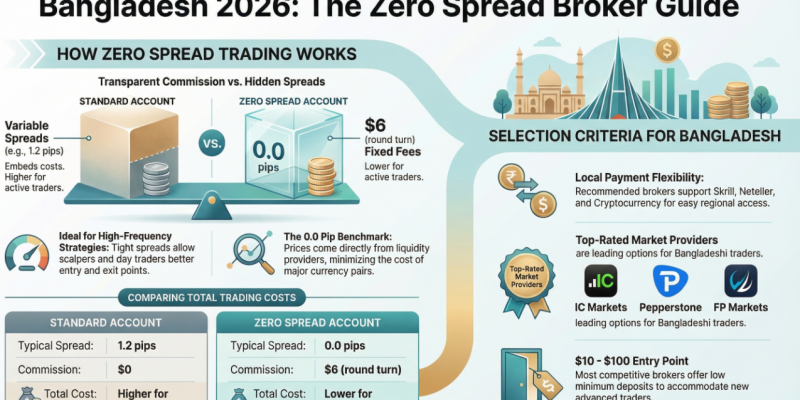
In the Forex market, trading costs play a crucial role in long-term profitability. Many traders search for zero spread brokers to reduce costs and improve trade execution. However, there is a common misconception that zero spread means free trading. In reality, zero spread brokers offer a different pricing model—one that can be highly beneficial when used correctly. This guide explains everything you need to know, including how zero spread accounts work, their advantages and disadvantages, and how traders in Bangladesh can choose the right broker.
What Are Zero Spread Brokers?
Zero spread brokers provide trading accounts where the spread starts from 0.0 pips, particularly on major currency pairs such as EUR/USD.
In a standard trading account:
- The broker earns through the spread (difference between bid and ask price)
In a zero spread account:
- The spread is minimized or eliminated
- The broker charges a fixed commission per trade
This model is widely used by brokers offering ECN (Electronic Communication Network) or RAW spread accounts, where prices come directly from liquidity providers.
How Zero Spread Accounts Work
To understand this model clearly, consider a simple example:
- EUR/USD spread: 0.0 pips
- Commission: $6 per lot (round turn)
In this case, the total trading cost is $6.
Unlike standard accounts where costs are hidden within spreads, zero spread accounts provide transparent pricing, allowing traders to calculate expenses more accurately.
Advantages of Zero Spread Brokers
1. Lower Trading Costs for Active Traders
Zero spread accounts can significantly reduce costs for traders who execute multiple trades daily.
2. Precise Trade Execution
Tighter spreads allow better entry and exit points, which is essential for strategies like scalping.
3. Transparent Fee Structure
All costs are clearly defined through commissions, making it easier to manage risk and profitability.
4. Access to Institutional Pricing
These accounts often provide direct access to interbank liquidity, improving overall trading conditions.
Disadvantages of Zero Spread Brokers
1. Commission Costs
Although spreads are low, commissions can increase total costs, especially for small trade sizes.
2. Variable Market Conditions
Spreads may not always remain at zero, particularly during:
- High-impact news events
- Low liquidity periods
3. Not Ideal for Beginners
New traders may find it difficult to evaluate commission-based pricing compared to simple spread-based accounts.
A key point to remember is that execution quality, slippage, and commission structure are more important than advertised spreads.
Best Zero Spread Brokers in Bangladesh
Below are some widely used brokers offering zero spread or raw spread accounts:
IC Markets
- Spread: From 0.0 pips
- Platforms: MT4, MT5, cTrader
- Known for fast execution and deep liquidity
- Suitable for scalping and automated trading
Pepperstone
- Spread: From 0.0 pips
- Strong regulatory framework
- High-speed execution environment
- Suitable for professional traders
FP Markets
- Competitive commission rates
- Reliable execution
- Suitable for traders transitioning to advanced strategies
Eightcap
- Low-cost trading environment
- Strong support for algorithmic trading
- User-friendly platform integration
XM (Zero Account)
- Offers zero spread account option
- Slightly higher commission structure
- Popular among Asian traders
Key Considerations for Traders in Bangladesh
When choosing a broker, traders in Bangladesh should evaluate the following factors:
Payment Methods
Ensure the broker supports convenient options such as:
- Skrill
- Neteller
- Cryptocurrency (Bitcoin, USDT)
- International bank transfers
Minimum Deposit
Many traders prefer brokers with low entry requirements, typically between $10 and $100.
Regulation and Safety
- Regulated brokers offer higher security
- Offshore brokers may provide flexibility but involve higher risk
Balancing safety and trading conditions is essential.
How to Choose the Best Zero Spread Broker
Before opening an account, consider these important criteria:
Execution Speed
Faster execution reduces slippage and improves trade accuracy.
Commission Structure
Compare commission rates carefully, as they directly affect profitability.
Liquidity Access
Brokers with multiple liquidity providers offer tighter spreads and better execution.
Trading Platform
Choose a platform that suits your strategy:
- MT4 for simplicity
- MT5 for advanced tools
- cTrader for professional trading features
Are Zero Spread Brokers Really Cheaper?
The answer depends on your trading style.
| Account Type | Spread | Commission | Total Cost |
|---|---|---|---|
| Standard Account | 1.2 pips | $0 | Higher overall |
| Zero Spread Account | 0.0 pips | $6 | Lower for active traders |
For high-frequency traders, zero spread accounts are usually more cost-effective. However, for beginners or low-volume traders, standard accounts may be more suitable.
Who Should Use Zero Spread Brokers?
Zero spread accounts are most suitable for:
- Scalpers
- Day traders
- High-frequency traders
- Algorithmic traders
Traders who place fewer trades may not benefit as much from this pricing model.
Final Verdict
Zero spread brokers offer a transparent and efficient trading environment, but they are not universally the best option for every trader.
The most effective approach is to evaluate:
- Total trading cost (spread + commission)
- Execution quality
- Broker reliability and regulation
Successful traders focus on overall trading conditions, not just low spreads.